

Q: What factors should I consider when selecting sprayer tips?
A: The most important thing you need to do is read the pesticide label and note the manufacturer’s instructions. Select sprayer tips that meet the recommendations for:
-
- Spraying technique – banding or broadcast
- Sprayer speed
- Application rate
- Flow rate
- Spray pattern
- Tip size and pressure
- Spray quality
Q: What figures do I need to know to calculate spray tips?
A: In order to accurately size a spray tip, we must first know if you are spraying water/chemical or fertilizer. If you are using fertilizer you must take your end figure and multiply by 1.13 for 28% or 1.15 for 10-34-0.
-
- Gallon Per Acre
- Miles Per Hour of Travel
- Spacing of Nozzles on Sprayer
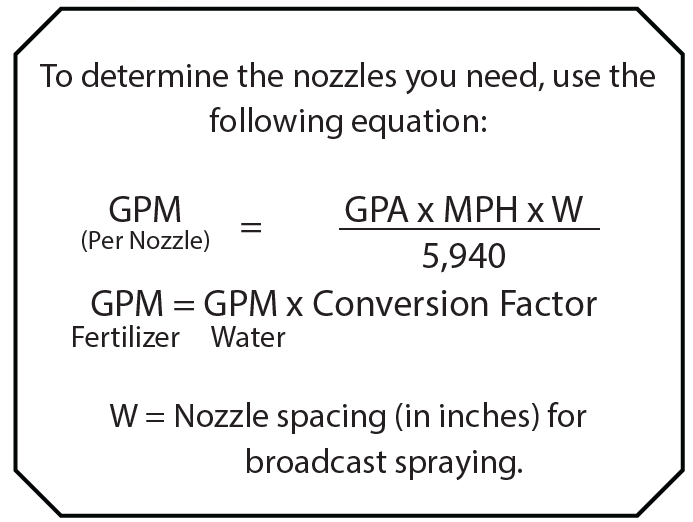
Q: How do I calculate spray tips and orifices?
A: Spray Tips and Nozzles are calculated by using the Gallon Per Acre, Mile Per Hour, and Spacing of Nozzles of the Application. If you are using fertilizer you must take your end figure and multiply by the conversion factor 1.13 for 28% (10.65 lbs/gallon) or 1.15 for 10-34-0(11 lbs/gallon).
Q: When is moisture testing with a Dickey-john moister tester most important?
A: Harvest – Moisture testing provides the knowledge to make informed decisions. Using a Dickey-john moisture tester onsite can facilitate the prioritization of where to harvest. An error of 1% moisture in a 100 acre field amounts to thousands of dollars. Know when to move equipment, and plan harvesting by location and moisture. If you spend half of the day moving equipment to the wrong field it can easily cost hundreds in fuel and man hours alone.
Storage – Understanding storage considerations can maximize the overall investment. Decisions can be made regarding when to blend grain based on moisture levels thus mitigating a wet, harvest product.
At the Time of Sale – Everyone wants to maximize profits and time management should not be forgotten when considering profit returns.
Q: How do I choose the right Dickey-john moisture tester for my application?
A: For a versatile, portable tester, choose the Dickey-john mini GAC 2500. Dickey-john took great pains to port the technology from the industry-standard GAC2500/2700 into a handheld. Drawing from the same library of calibrations, it is a superior value. For a mobile operation, the Dickey-john GAC500XT is a good choice. The semi-automatic tester provides moisture and test weight and operates off 12 VDC or from AC power. Performance is comparable to the federal-standard GAC2100. For a fully-automatic non-portable tester choose the GAC 2700. The Dickey-john GAC Series moisture testers have temperature compensation that is vital to accurate moisture.
Q. Can my fertilizer equipment be used for spreading lime?
A: This is a very good question, and in most cases the answer would be no. However, there are a few cases in which your fertilizer equipment can be used for spreading lime. If your fertilizer spreader has a 16” or larger bed chain, and twin motor drive on the conveyor on hydraulic models, it will spread lime. If it is a press wheel drive and has dual drive chains, or a 60 heavy chain with a 16” or larger bed chain, it will spread lime.
Q: Are the Shurflo pumps that you retail the same as the Shurflo pumps that fit in my camper?
A: Shurflo Pumps, especially the Classic 2088, are the world’s most popular RV pumps. The classic Shurflo pumps have been serving the needs of motor home and RV owners for many years. Three independent pumping chambers give you three-way dependability. Classic Shurflo pumps are designed for multiple-fixture intermittent duty applications and include such features as: quiet performance, self priming, running dry without damage, and a built-in check valve.